Don't let student progress disappear into tutor notes.
Keep assessments and teaching evidence connected to each student so your team can see how learning is changing over time — not just what happened in the last session.
Build a learning record as you teach.
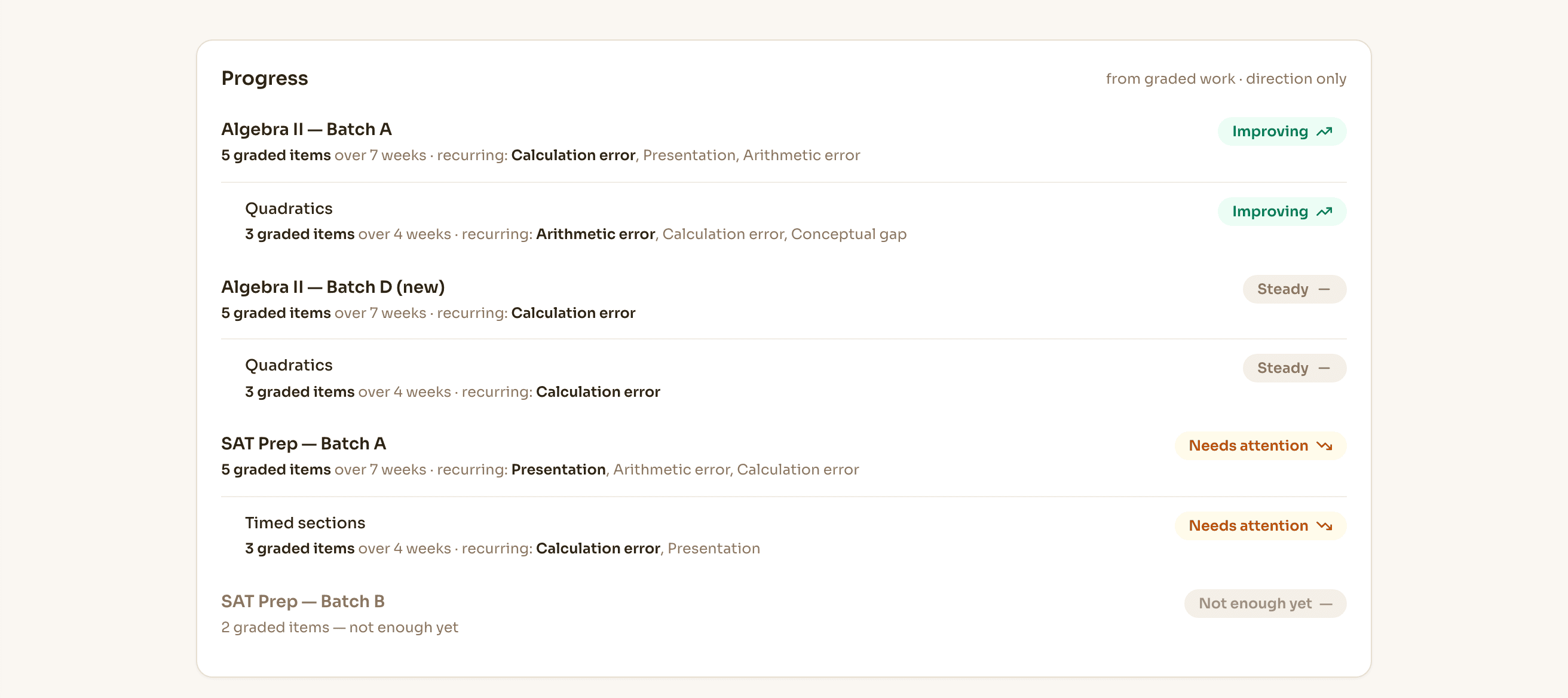
Capture scores and learning evidence as part of the normal teaching workflow. Novano uses that evidence to build cautious trajectories for each class a student is in — and, where tutors record a topic, for each topic within it.
A trajectory reads as improving, steady or needs attention — or not enough yet, which Novano will say rather than guess.
Every trajectory carries what it was built from: how many assessments, over what period, and which errors keep recurring.
Teaching evidence belongs to the center.
When multiple tutors work with the same student, progress shouldn't live only in one person's memory.
A shared record gives the center continuity when tutors change, and helps owners understand the educational side of the operation — not just the operational one.
From learning signal to action.
The long-term value of learning data is not another dashboard. It is knowing when a student may need attention, and giving the tutor or center a clear place to respond.
- Assessment recorded
- Trajectory updates
- Tutor or owner sees the direction
- Staff task or parent conversation
Good to know
What does a trajectory actually tell me?
A direction on a class — or on a topic within it, where tutors record one — reading improving, steady, needs attention, or not enough yet. Each carries the evidence behind it: how many assessments it drew on, over what period, and the errors that keep recurring. It reports direction, not a score.
What if there isn't enough data?
It says so. Below a density threshold Novano reports 'not enough yet' rather than guessing a direction. That's deliberate — a confident-looking signal built on two data points would be worse than silence.
Does it predict how a student will do?
No. Novano reports the direction the evidence already shows. It doesn't forecast outcomes or produce a mastery score.
What happens when a tutor leaves?
The student's assessments, teaching evidence and history stay with the student, so whoever picks them up inherits the record rather than starting over.
Can parents see it?
Parents see progress for their own children through their own secure sign-in.